
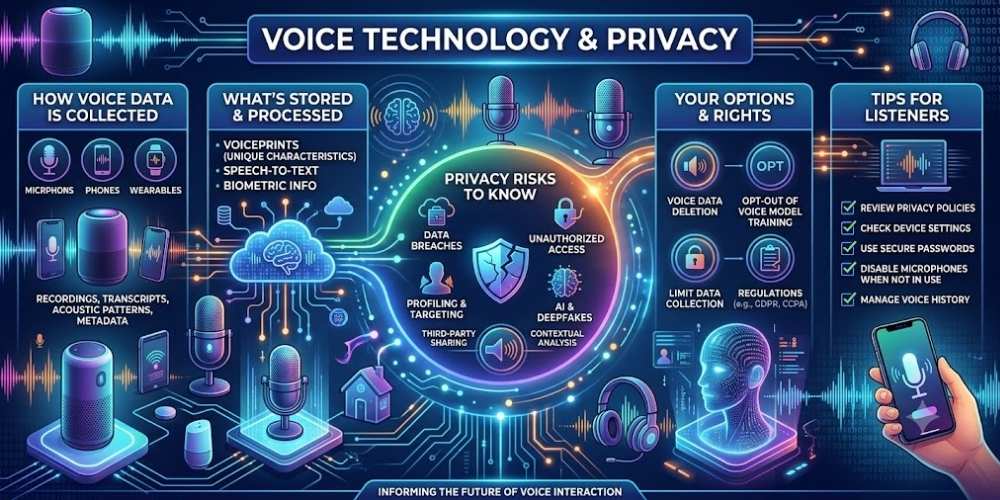
Voice Technology and Privacy: What Listeners Should Know
voice technology privacy is a topic that attracts plenty of confident opinions, yet the best answer usually depends on the listener, room, device, workflow, and distribution goal. This guide explains the subject without assuming that the most expensive or newest option is automatically the right one.
A practical privacy guide for people using smart speakers, voice assistants, transcription services, and connected audio devices. We will focus on decisions that can be tested, documented, and adjusted instead of relying on vague claims.
Why Voice Technology Privacy Matters
Good audio decisions are contextual. A broadcaster serving mobile listeners has different priorities from a mastering engineer, while a home podcaster faces different acoustic limits from a commercial studio.
The subject matters because audio systems are chains. A strong microphone cannot rescue a noisy room, and a high-resolution file cannot overcome poor playback hardware or an unstable connection. Every stage should support the next one.
- Define the audience and listening environment.
- Identify the weakest part of the current workflow.
- Choose measurable improvements rather than decorative features.
- Keep the process simple enough to repeat consistently.
How to Evaluate Voice Technology Privacy
Start with a specific use case. Write down where the audio begins, how it is processed, how it is delivered, and where it is heard. This prevents one specification from dominating the decision.
| Evaluation Area | Questions to Ask | Practical Test |
|---|---|---|
| Source | Is the original signal clean and appropriate? | Compare an untreated sample with the final result. |
| Workflow | Can the process be repeated without confusion? | Ask another person to follow the documented steps. |
| Delivery | Does the format suit the network and audience? | Test on Wi-Fi, mobile data, and a slower connection. |
| Playback | Does it work on typical listener devices? | Check headphones, speakers, a phone, and a laptop. |
Key Technical Factors
Signal Quality
Signal quality begins before processing. Good gain structure, sensible levels, and controlled background noise create more improvement than aggressive cleanup later. Leave enough headroom to avoid clipping and unexpected peaks.
Compatibility
A technically excellent option can still fail if it is difficult to open, stream, connect, or maintain. Compatibility includes operating systems, mobile devices, browsers, vehicles, smart speakers, and assistive technology.
Reliability
Reliability is part of quality. A slightly less ambitious setup that works every day is usually better than a fragile system that depends on perfect conditions.
Cost Over Time
Consider subscriptions, storage, bandwidth, replacement parts, cables, batteries, training, and migration. The purchase price is only one part of the real cost.
A Step-by-Step Decision Process
- Define the outcome. Describe what should improve and how you will notice it.
- Set constraints. Record budget, space, compatibility, deadlines, and available skills.
- Build a shortlist. Remove options that fail essential requirements before comparing extras.
- Run a realistic test. Use normal content, normal devices, and the actual room or network.
- Document the result. Save settings and explain why the decision was made.
- Review later. Revisit the setup after real use rather than replacing it immediately.
Common Mistakes to Avoid
- Buying by specification alone: A larger number may not improve the intended workflow.
- Ignoring the room or network: Environmental limits often matter more than premium equipment.
- Changing several variables at once: You lose the ability to identify what improved or damaged the result.
- Skipping backups: Live and production workflows need a fallback for power, connectivity, files, or hardware.
- Using one test track: Evaluate speech, dense music, quiet passages, and real program material.
When an Upgrade Is Worth It
An upgrade is justified when it solves a documented limitation. Examples include audible noise, unreliable connections, insufficient inputs, uncomfortable monitoring, slow editing, poor speech intelligibility, or a format that does not reach the intended audience.
Upgrading simply because a new version exists is less convincing. First check placement, settings, maintenance, firmware, room treatment, and workflow habits. These often deliver meaningful improvements without replacing the main equipment.
Best Practices for Long-Term Results
In audio news, small technical choices often create larger workflow consequences. A setting that looks impressive on a product page may add cost, complexity, or larger files without improving the experience for the intended audience.
- Keep firmware and applications updated after testing compatibility.
- Use clear file names, version numbers, and backup locations.
- Label cables, inputs, buses, and presets.
- Measure loudness and peaks instead of guessing.
- Review analytics without letting metrics replace editorial judgment.
- Protect accounts with unique passwords and multi-factor authentication.
What to Watch Next
Watch standards bodies, platform documentation, device support, and actual adoption rather than launch announcements alone. The most meaningful changes are those that improve compatibility, accessibility, reliability, or production speed.
Professionals usually improve results by reducing uncertainty. They document settings, test one variable at a time, keep backups, and compare outcomes in the environment where the work will actually be used.
Practical Check 1: Verify the Full Chain
Voice Technology and Privacy: What Listeners Should Know is easier to understand when you separate marketing language from the decisions that affect real listening, recording, or distribution. The useful questions are practical: what problem are you trying to solve, which constraints matter, and how will you judge the result? Review the source, processing, delivery, and playback stages together. Record what you hear, what the meters show, and what users report. This creates evidence for the next decision instead of another round of guesswork.
Practical Check 2: Verify the Full Chain
In audio news, small technical choices often create larger workflow consequences. A setting that looks impressive on a product page may add cost, complexity, or larger files without improving the experience for the intended audience. Review the source, processing, delivery, and playback stages together. Record what you hear, what the meters show, and what users report. This creates evidence for the next decision instead of another round of guesswork.
Practical Check 3: Verify the Full Chain
The goal is not to chase the highest specification. It is to build a dependable chain from source to listener. That means considering the room, connection, device, software, format, and people using the system together. Review the source, processing, delivery, and playback stages together. Record what you hear, what the meters show, and what users report. This creates evidence for the next decision instead of another round of guesswork.
Practical Check 4: Verify the Full Chain
Professionals usually improve results by reducing uncertainty. They document settings, test one variable at a time, keep backups, and compare outcomes in the environment where the work will actually be used. Review the source, processing, delivery, and playback stages together. Record what you hear, what the meters show, and what users report. This creates evidence for the next decision instead of another round of guesswork.
Practical Check 5: Verify the Full Chain
Good audio decisions are contextual. A broadcaster serving mobile listeners has different priorities from a mastering engineer, while a home podcaster faces different acoustic limits from a commercial studio. Review the source, processing, delivery, and playback stages together. Record what you hear, what the meters show, and what users report. This creates evidence for the next decision instead of another round of guesswork.
Practical Check 6: Verify the Full Chain
Voice Technology and Privacy: What Listeners Should Know is easier to understand when you separate marketing language from the decisions that affect real listening, recording, or distribution. The useful questions are practical: what problem are you trying to solve, which constraints matter, and how will you judge the result? Review the source, processing, delivery, and playback stages together. Record what you hear, what the meters show, and what users report. This creates evidence for the next decision instead of another round of guesswork.
Practical Check 7: Verify the Full Chain
In audio news, small technical choices often create larger workflow consequences. A setting that looks impressive on a product page may add cost, complexity, or larger files without improving the experience for the intended audience. Review the source, processing, delivery, and playback stages together. Record what you hear, what the meters show, and what users report. This creates evidence for the next decision instead of another round of guesswork.
Conclusion
Voice Technology and Privacy: What Listeners Should Know should be approached as a practical decision, not a contest for the most impressive specification. Start with the audience and workflow, identify the real limitation, test under normal conditions, and document what changes.
That approach produces better value and more consistent audio. It also makes future upgrades easier because you will know which part of the chain needs attention and which parts are already working well.
Frequently Asked Questions
What is the most important thing to know about voice technology privacy?
The most important point is to match the choice to a specific workflow, audience, and environment rather than relying on a single specification.
How can beginners evaluate voice technology privacy?
Beginners should define the intended use, compare a small shortlist, test with familiar material, and check compatibility on the devices they actually use.
Does spending more always improve voice technology privacy?
No. Higher cost can provide better build quality, features, support, or performance, but only when those improvements address a real limitation.
Related Articles

Moskva.fm Editorial Team is dedicated to delivering trusted news, expert reviews, and in-depth guides covering internet radio, podcasts, music streaming, broadcasting technology, studio equipment, and digital audio innovation. Our mission is to help readers stay informed about the latest developments shaping the global audio industry through accurate, well-researched, and high-quality editorial content.